
A wound may begin as a simple cut, surgical incision, burn, or pressure injury—but its healing journey is never simple.For many patients, especially elderly individuals, post-surgical cases, diabetic patients, or those with limited mobility, wound care becomes a daily concern that requires consistency, attention, and clinical guidance. Even a small lapse in care can increase the risk of infection or delay healing.
At the same time, repeated hospital visits for dressing changes can feel physically tiring and emotionally stressful for both patients and caregivers. This is where Wound Dressing at Home becomes an important extension of modern healthcare—bringing professional, sterile, and clinically guided wound management directly to the patient’s home, ensuring healing continues safely in a familiar and supportive environment.
Why Proper Wound Care Matters More Than It Seems
A wound does not heal just because time passes. It heals when the environment around it supports tissue repair, prevents infection, and maintains proper moisture balance.Even a minor wound can become complicated if it is not managed correctly in the early stages.
Proper wound care ensures:
- Protection Against Infection: A correctly dressed wound creates a controlled barrier that prevents bacteria from entering, reducing the risk of infection that can delay or complicate healing.
- Faster and Structured Healing: Clean wound surfaces, appropriate dressings, and controlled moisture levels help new tissue form in a stable environment.
- Early Detection of Complications: Regular assessment allows healthcare professionals to identify subtle changes like redness, swelling, or abnormal discharge before they progress.
- Reduced Pain and Tissue Stress: Modern dressings are designed to protect exposed nerve endings and reduce friction during movement or dressing changes.
- Better Outcomes for High-Risk Patients: For diabetic, elderly, or immunocompromised patients, proper wound care significantly reduces the risk of chronic non-healing wounds.
A wound may be small—but its care determines how safely the body can rebuild itself. Proper Wound Dressing at Home plays a vital role in protecting the injury, supporting healing, and reducing the risk of complications.
What Is Professional Wound Dressing at Home?
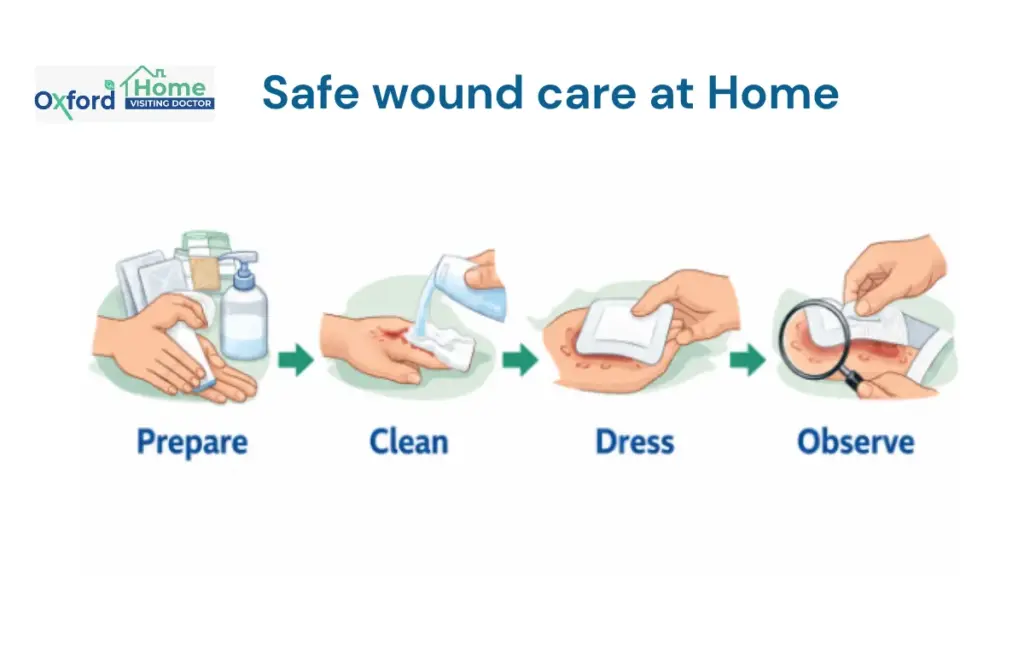
Wound Management Home Service is a professional wound dressing and clinical wound management service delivered at the patient’s residence by trained healthcare professionals. It follows evidence-based wound care practices and involves systematic wound assessment, sterile cleaning, appropriate dressing selection, infection prevention measures, and continuous monitoring of healing progress using standardized clinical protocols. The service aims to provide safe, effective, and personalized wound care while supporting faster recovery and improved patient comfort at home.
Unlike simple bandage replacement, this service focuses on active wound management, where every dressing change is guided by the wound’s current condition, healing stage, and risk profile.
A typical home wound dressing visit includes the following clinical components:
Clinical Wound Assessment
- Clinical wound assessment is a fundamental component of effective wound management and plays a vital role in developing a personalized care plan for each patient.
- In Critical Care at Home, every wound care session begins with a comprehensive evaluation performed by trained healthcare professionals to understand the current condition of the wound, identify potential complications, and determine the most suitable treatment approach.
Sterile Wound Cleaning and Debridement Support
- The wound is carefully cleansed using medically approved antiseptic or saline solutions based on clinical need. The objective is to remove surface contaminants, excess exudate, and non-viable tissue while preserving healthy granulation tissue that is essential for regeneration.
- Maintaining a clean wound bed significantly reduces bacterial load and creates an optimal environment for tissue repair.
Evidence-Based Dressing Selection
Dressing selection is not standardized—it is tailored according to wound type, moisture balance, depth, and infection status.
- Wounds with high exudate may require foam or highly absorbent dressings to maintain moisture balance without maceration.
- Dry or shallow wounds benefit from moisture-retentive dressings that prevent tissue dehydration and support epithelial migration.
- Infected or high-risk wounds may require antimicrobial dressings to help control bacterial load.
- Deep or tunneling wounds often require alginate or specialized packing materials to support cavity filling and proper healing from the base upward.
This individualized selection ensures that each wound receives the most appropriate micro-environment for healing.
Monitoring of Healing Progress
- At every visit, the wound is reassessed to track measurable healing indicators such as reduction in wound size, improvement in tissue quality, decrease in exudate levels, and absence of infection markers.
- This continuous monitoring allows early identification of complications and ensures timely modification of the treatment plan when required.
Patient and Caregiver Education
- Caregivers are guided on essential aspects of wound management between dressing sessions, including hygiene maintenance, safe mobility practices, nutritional support for tissue repair, and early warning signs that require medical attention.
- This step ensures continuity of care beyond the clinical visit and significantly improves long-term healing outcomes.
Clinical Outcome Perspective
- Professional Wound Dressing at Home shifts wound care from a reactive process to a structured healing strategy, helping identify concerns early and supporting better recovery outcomes.
- Guided by clinical observation, evidence-based decisions, and regular reassessment, Wound Dressing at Home helps ensure appropriate care adjustments throughout the healing journey.
Things to Know Before Dressing a Wound at Home
Proper wound care begins even before the dressing is applied. Effective Wound Dressing at Home involves careful assessment, proper preparation, and timely care practices to support safe healing and reduce the risk of complications.
Understanding these fundamentals can significantly reduce complications:
- Every wound behaves differently: Surgical wounds, burns, diabetic ulcers, and pressure injuries all follow different healing patterns and require different dressing strategies.
- Avoid unapproved substances: Applying powders, oils, or home remedies may disrupt tissue repair and increase infection risk instead of helping healing.
- Clean environment is essential: Even minor contamination during dressing can introduce bacteria and delay recovery.
- Do not disturb the healing layer unnecessarily: Repeatedly removing dressings can damage newly forming tissue and slow down regeneration.
- Medical guidance should always lead care decisions: Dressing frequency, medication use, and wound monitoring should be based on clinical assessment, not assumptions.
Good healing begins before the first touch of the dressing.
Different Types of Wounds
Every wound follows a different healing pathway depending on its cause, depth, and patient health condition.
- Surgical Wounds: Controlled incisions that usually heal steadily with proper sterile care and monitoring.
- Diabetic Wounds: Slow-healing wounds due to reduced blood circulation and nerve sensitivity, requiring strict monitoring.
- Pressure Injuries: Caused by prolonged pressure on skin areas, often seen in bedridden patients and requiring frequent repositioning.
- Burn Wounds: Require careful protection of damaged skin layers and infection control.
- Traumatic Wounds: Cuts, lacerations, and abrasions that require thorough cleaning and infection prevention.
- Chronic Ulcers: Long-standing wounds often linked to circulation issues that require long-term structured care.
Despite their differences, all wounds share one requirement—consistent, appropriate care at every stage of healing. Wound Dressing at Home ensures patients receive timely, professional care that supports recovery, minimizes the risk of complications, and promotes optimal healing in the comfort of their own homes.
Understanding the Stages of Wound Healing
Wound Dressing at Home supports every stage of healing by protecting the wound, promoting faster recovery, and reducing the risk of complications.While the timeline may vary depending on the type of wound, age, nutrition status, circulation, and underlying conditions such as diabetes, the physiological sequence of healing generally follows three key phases:
Inflammatory Stage (Day 1–4)
- This is the body’s immediate protective response to injury. As soon as tissue damage occurs, blood vessels constrict briefly to reduce bleeding, followed by platelet activation and clot formation (hemostasis). This creates a temporary protective barrier over the wound. Simultaneously, white blood cells—particularly neutrophils and macrophages—migrate to the site to eliminate bacteria, remove debris, and begin preparing the wound bed for repair.
- During this phase, mild redness, warmth, swelling, and localized tenderness are expected and indicate an active healing response, not necessarily infection.
Proliferative Stage (Day 4–21)
- This phase focuses on rebuilding damaged tissue.Fibroblasts play a central role by producing collagen, which forms the structural framework of new tissue. At the same time, angiogenesis (formation of new blood vessels) improves oxygen and nutrient supply to the healing area.
- Granulation tissue begins to form, giving the wound a pink or reddish appearance, while epithelial cells gradually migrate across the wound surface to close the defect. Clinically, this is the phase where visible wound contraction and reduction in size become noticeable, assuming there are no complications.
Remodeling (Maturation) Stage (Weeks to Months)
- This is the final and longest phase of healing.The newly formed collagen fibers are gradually reorganized, strengthened, and aligned along tension lines to improve tissue durability. Excess blood vessels formed during earlier stages regress, and the wound slowly regains structural integrity.
- Although the wound may appear closed externally, internal strengthening continues for several months, and the tissue remains vulnerable to stress during early remodeling.
Clinical Significance
Understanding these stages is important because wound appearance alone can be misleading. A wound that looks “red” is not always infected, and a closed surface does not always indicate complete healing.
For healthcare professionals, evaluation is always based on:
- Wound progression across stages
- Tissue quality (granulation vs slough vs necrosis)
- Exudate pattern
- Surrounding skin condition
- Patient risk factors (especially diabetes, vascular disease, and immunity status)
Signs a Wound Needs Immediate Medical Attention
While many wounds heal with proper care, some require prompt medical evaluation to prevent serious complications. Recognizing these warning signs early can make a significant difference in the healing process and may even prevent hospitalization.
If you notice any of the following symptoms, seek professional medical attention without delay:
- Increasing Redness and Swelling: Mild redness is common during the early stages of healing, but redness that spreads beyond the wound, accompanied by increasing swelling or warmth, may indicate an infection that requires immediate assessment.
- Persistent or Severe Pain: A wound should gradually become less painful as it heals. If the pain suddenly worsens or becomes severe despite treatment, it could signal an underlying complication.
- Pus or Foul-Smelling Discharge: Thick yellow, green, or cloudy drainage, particularly when accompanied by an unpleasant odor, is often a sign of wound infection and should never be ignored.
- Persistent Bleeding: Bleeding that continues despite applying gentle pressure, or bleeding that restarts unexpectedly, requires urgent medical evaluation to identify the underlying cause.
- Fever or Chills: When a wound infection begins affecting the body beyond the injured area, symptoms such as fever, chills, fatigue, or weakness may develop, requiring prompt medical attention.
- Black, Grey, or Dead Tissue: Darkened tissue around a wound may indicate poor blood supply or tissue death (necrosis). This is a serious finding that requires immediate professional assessment.
- Delayed Healing: If a wound shows little or no improvement after several days, or appears to become larger instead of smaller, it should be evaluated to identify factors that may be delaying recovery.
Early recognition of these warning signs allows timely medical intervention, helping prevent small wound problems from developing into serious health complications.
Benefits of Wound Dressing at Home
Proper wound management is about far more than replacing a bandage. Wound Dressing at Home combines clinical expertise, careful monitoring, and evidence-based care to create the best possible conditions for healing while allowing patients to recover safely and comfortably in their own homes. This personalized approach supports timely intervention, reduces the risk of complications, promotes faster recovery, and ensures every stage of the healing process is managed with professional attention and compassionate care.
Some of the key benefits include:
- Lower Risk of Infection: Professional wound cleaning and sterile dressing techniques help protect the wound from harmful bacteria, reducing the likelihood of infection and promoting healthier healing.
- Appropriate Dressing for Every Stage of Healing: As a wound changes during recovery, its dressing requirements may also change. Healthcare professionals select suitable dressing materials based on the wound’s condition rather than using a one-size-fits-all approach.
- Continuous Monitoring of Healing Progress: Every dressing change provides an opportunity to assess healing, identify concerns early, and modify the care plan whenever necessary, helping prevent avoidable complications.
- Greater Comfort for the Patient: Receiving wound care at home eliminates unnecessary travel and waiting times while allowing patients to recover in a familiar, less stressful environment.
- Guidance for Family Members and Caregivers: Caregivers receive practical advice on hygiene, wound protection, nutrition, and warning signs to watch for, helping them support recovery confidently between professional visits.
Professional wound care is not only about healing today’s wound—it is about reducing tomorrow’s risks through consistent, expert Wound Care at Home. With proper guidance and ongoing attention, patients can support safer healing and better long-term outcomes.
How Home Wound Dressing Works
Home wound dressing follows a structured clinical process designed to provide safe, hygienic, and personalized care while monitoring healing at every visit.
| Step | What Happens |
| Initial Assessment | The healthcare professional examines the wound, reviews your medical history, and evaluates healing progress before beginning treatment. |
| Wound Cleaning | The wound is gently cleaned using clinically appropriate techniques to remove debris, old drainage, and contaminants while protecting healthy tissue. |
| Professional Dressing | A suitable dressing is selected based on the wound type, level of drainage, and stage of healing to create the best environment for recovery. |
| Healing Evaluation | Every visit includes monitoring for improvement, early signs of infection, and any changes that may require adjustments to the treatment plan. |
| Patient & Caregiver Education | Practical guidance is provided on protecting the wound, maintaining hygiene, and recognizing warning signs between dressing changes. |
| Follow-Up Care | Dressing changes continue according to the recommended schedule until the wound has healed or further medical treatment is advised. |
A structured approach ensures that every dressing change contributes to safe healing rather than simply covering the wound.
Caring for Your Wound Between Dressing Sessions
Professional wound dressing is only one part of the healing process. The care provided between scheduled visits plays an equally important role in protecting the wound and supporting recovery.
To promote healthy healing:
- Keep the Dressing Clean and Dry: Moisture or contamination can increase the risk of infection. Unless advised otherwise, avoid wetting the dressing during bathing or daily activities.
- Avoid Touching or Removing the Dressing: Frequent handling can introduce bacteria and disturb newly formed tissue. Only change or remove the dressing when instructed by your healthcare professional.
- Eat a Balanced, Protein-Rich Diet: Nutrients such as protein, vitamin C, zinc, and adequate hydration support tissue repair and help the body heal more efficiently.
- Manage Underlying Health Conditions: Patients with diabetes should monitor blood sugar carefully, as uncontrolled glucose levels can significantly slow wound healing and increase infection risk.
- Reduce Pressure on the Wound: If the wound is located on the foot, heel, or other pressure-prone areas, following advice on positioning and mobility can help prevent further tissue damage.
- Monitor for Any Changes: If you notice increased pain, swelling, redness, unusual discharge, or fever, contact your healthcare provider promptly rather than waiting for the next dressing appointment.
Consistent care between visits creates the ideal environment for healing and helps reduce the likelihood of preventable complications.
Why Families Trust Professional Wound Care at Home
When someone is recovering from a wound, they are placing more than their health in the hands of a healthcare professional—they are placing their trust. That trust is built through clinical expertise, compassionate care, and a commitment to achieving the best possible healing outcomes.
- Experienced Wound Care Professionals: Our wound care team is trained to assess different types of wounds, select appropriate dressing techniques, monitor healing progress, and identify potential complications at an early stage, ensuring every patient receives individualized care.
- Strict Infection Prevention Standards: Every dressing procedure follows established infection control practices using appropriate hygiene protocols and sterile techniques to minimize contamination and support safe recovery.
- Evidence-Based Wound Management: No two wounds heal in exactly the same way. Every treatment plan is guided by the patient’s condition, wound type, stage of healing, and current clinical needs rather than a standardized approach.
- Clear Communication and Family Education: Recovery continues between professional visits. We ensure that patients and caregivers understand how to protect the wound, recognize warning signs, and confidently support the healing process at home.
- Continuous Monitoring for Better Outcomes: Healing is carefully reviewed during every visit, allowing changes to the care plan whenever necessary and ensuring that concerns are addressed before they become larger problems.
Quality wound care is built on clinical excellence, careful observation, and compassionate support—helping every patient recover with greater confidence and peace of mind.
Common Myths About Wound Care
Misinformation often leads to delayed healing and unnecessary complications. Understanding the facts helps patients make safer decisions and avoid practices that may interfere with recovery.
- Myth: Leaving a wound uncovered helps it heal faster.
Reality: Most wounds heal more effectively when protected with an appropriate dressing that maintains a clean, moisture-balanced healing environment. - Myth: Every wound needs daily dressing changes.
Reality: The ideal dressing schedule depends on the wound type, amount of drainage, and stage of healing. Changing dressings too frequently may disturb newly formed tissue. - Myth: Home remedies are always safe for wounds.
Reality: Applying powders, oils, toothpaste, or other unapproved substances may damage healthy tissue, increase infection risk, and delay healing. - Myth: If the wound doesn’t hurt, it must be healing well.
Reality: Some serious wounds, particularly in people with diabetes or nerve damage, may cause little pain despite developing significant complications. - Myth: Antibiotics alone heal wounds.
Reality: Antibiotics treat bacterial infections when prescribed appropriately, but effective wound healing also depends on proper cleaning, suitable dressings, nutrition, blood circulation, and ongoing monitoring.
Understanding the facts empowers patients and families to make informed decisions that support safer, healthier recovery.
Conclusion
Wound healing is not just about covering an injury—it is about guiding the body through a delicate biological process with care, precision, and consistency. Wound Dressing at Home provides patients with structured clinical care in the comfort of their own environment, helping protect the wound, manage moisture, and support healthy tissue repair.
This personalized approach reduces the risk of infection, enhances comfort, and promotes safer recovery while minimizing unnecessary hospital visits. Every dressing is more than a routine procedure—it is a vital step toward complete healing, where timely intervention, expert care, and consistent monitoring contribute to better outcomes and long-term recovery.
Read more: Medicine delivery at home